







Most homeowners discover mold in their air ducts the same way: a musty smell kicks in the moment the AC turns on, and it does not go away. By the time that smell is noticeable, mold has usually been growing in the system for a while.
That is the problem with duct mold. It develops in dark, enclosed spaces where you cannot see it, and it gets distributed through every room in the house every time your system runs. The CDC confirms that mold exposure can cause a range of health effects from stuffy nose and coughing to severe respiratory reactions, particularly in people with asthma, allergies, or compromised immune systems.
In Las Vegas, the risk is specific. The city’s extreme heat, monsoon moisture spikes, and year-round AC use create conditions that accelerate mold growth inside ductwork faster than most homeowners expect. This guide covers everything you need to know: what causes it, how to spot it, what you can safely handle yourself, when to call a professional, and how to keep it from coming back.
Key Takeaways
- Mold in air ducts spreads spores throughout your home every time your HVAC system runs
- Las Vegas monsoon season, condensation from extreme heat differentials, and year-round AC use all accelerate mold growth in ductwork
- A musty smell when your system kicks on is the most common early sign
- DIY cleaning is only safe for surface mold on vent covers. Anything deeper requires professional equipment
- Never use bleach on ductwork. It does not penetrate mold roots and can damage metal surfaces
- NADCA-certified professionals use negative pressure vacuuming and EPA-registered disinfectants to fully remediate duct mold
- Preventing moisture from entering your system is the single most effective way to stop mold from returning
What Causes Mold in Air Ducts
Mold needs two things to grow: organic material to feed on and moisture. Your ductwork provides both. Dust, dander, and debris accumulate inside ducts over time, giving mold spores exactly the food source they need. Add moisture and the conditions are set.
Here is where that moisture comes from in Las Vegas specifically:
Monsoon season. Las Vegas gets most of its annual rainfall in a concentrated window from July through September. That sudden spike in humidity after months of bone-dry air creates condensation inside cooled ductwork, particularly in attic spaces where temperature differentials are extreme. A few weeks of elevated humidity is enough for mold to take hold.
Condensation from heat differentials. Las Vegas attic temperatures can exceed 150 degrees in summer. When cold conditioned air moves through ducts running through that attic space, the temperature difference creates condensation on duct surfaces. Poorly insulated or aging ductwork is especially vulnerable.
Condensate drain issues. Your AC unit removes humidity from the air as it cools it. That moisture drains away through a condensate line. When that line gets clogged or the drain pan overflows, moisture backs up into the system and creates ideal mold conditions near the air handler and in adjacent ductwork.
Leaky ducts. Gaps, disconnected sections, or damaged ductwork allow warm humid air from attic or crawl space environments to enter the system. That outside air brings moisture and mold spores directly into your ductwork.
Neglected maintenance. Systems that have not been cleaned or inspected in years accumulate the dust and debris that feed mold growth. Combined with any of the moisture sources above, that buildup becomes a breeding ground.
Signs You Have Mold in Your Air Ducts
Mold in ductwork rarely announces itself clearly. The signs are often subtle and easy to attribute to something else. Here is what to watch for:
Musty or earthy smell when the system runs. This is the most reliable early indicator. A clean HVAC system produces no noticeable odor. A persistent earthy or musty smell that appears the moment the AC or heat kicks on, and disappears when it shuts off, points directly at the ductwork.
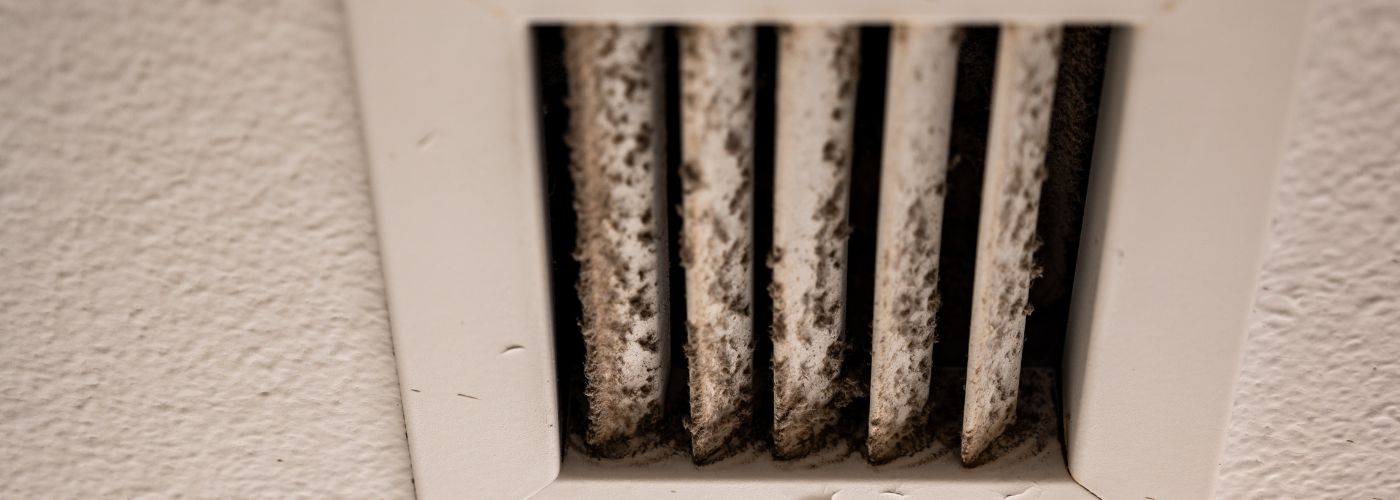
Visible dark spots around vent covers. Black, green, or gray spots on or around vent grilles are a clear warning sign. Sometimes this appears as dark streaking on the wall near a vent. The mold has reached the point where it is visible at the exit point of the duct.
Worsening allergy or respiratory symptoms indoors. If symptoms are consistently worse at home than outside, your ducts are likely recirculating mold spores. This pattern, symptoms improving when you leave and returning when you come back, is one of the clearest signals of a duct contamination problem.
Symptoms in multiple rooms simultaneously. When mold is localized to one area of a home, symptoms tend to be localized too. When the source is the duct system, spores spread to every room. Multiple family members experiencing similar symptoms in different parts of the house is a significant red flag.
Recent water event near ductwork. A roof leak, flooding, burst pipe, or condensate overflow near your air handler or duct runs should trigger an inspection even if you cannot see or smell mold yet. Mold can establish itself within 24 to 48 hours of moisture exposure.
Is Mold in Air Ducts Dangerous?
The health impact depends on several factors: the extent of contamination, which mold species are present, how long the exposure has continued, and who is in the household.
For most healthy adults, low-level mold exposure causes mild symptoms: nasal congestion, coughing, irritated eyes, or skin irritation. For people with asthma, allergies, or respiratory conditions, the effects can be significantly more severe. The CDC notes that people with asthma may have intense reactions to mold, and immune-compromised individuals can develop serious lung infections.
Children and elderly household members are most vulnerable. Studies have also linked prolonged mold exposure to cognitive symptoms including headaches, difficulty concentrating, and fatigue, according to research cited by the National Institute of Environmental Health Sciences.
The key factor with duct mold specifically is that it does not stay in one place. Every time your system runs, spores travel through the entire duct network and get deposited throughout your home. A small colony in one section of ductwork can contaminate an entire house relatively quickly.
What You Can Safely Do Yourself
DIY mold treatment has a narrow but real scope. If mold is limited to the surface of vent covers or the first few inches inside a duct opening, you can address it safely with the right approach.
What you need:
- N95 mask, gloves, and safety goggles
- HEPA filter vacuum
- EPA-registered mold cleaner formulated for HVAC use
- Microfiber cloths or soft brush
- Spray bottle with clean water
- Fan or dehumidifier for drying
The process:
Turn off your HVAC system completely at the thermostat and breaker before starting. Remove vent covers and set them aside for separate cleaning. Use your HEPA vacuum around the vent opening to remove loose debris and surface spores. A standard vacuum will recirculate spores rather than capture them.
Spray your EPA-registered mold cleaner on affected surfaces and let it sit for the time specified on the label. Never use bleach. It does not penetrate mold’s root structure effectively, can corrode metal ductwork, and produces fumes that become toxic when mixed with other HVAC residues.
Scrub gently with a microfiber cloth or soft brush. Wipe the area clean and rinse lightly with water. Dry everything completely with a fan or dehumidifier before restarting your system. Any remaining moisture will bring the mold back within days.
Replace your air filter before turning the system back on.
Stop here if: the mold extends beyond what you can reach, you smell mold in multiple rooms, you see dark patches that return after cleaning, or anyone in the household has asthma or respiratory conditions. These situations require professional remediation.
DIY vs. Professional: When to Stop and Call
| Situation | DIY Safe | Call a Professional |
| Mold on vent covers only | Yes | |
| Mold smell in one room | Possibly | |
| Mold smell throughout the house | Yes | |
| Visible mold inside ductwork | Yes | |
| Mold near coils, blower, or air handler | Yes | |
| Mold returns after cleaning | Yes | |
| Recent water damage or flooding | Yes | |
| Household members with asthma or allergies | Yes | |
| Mold covering more than one vent | Yes |
The EPA recommends professional remediation when mold contamination covers more than 10 square feet or involves inaccessible areas like duct interiors. By definition, most ductwork mold problems qualify.
How Professional Air Duct Mold Cleaning Works
Professional remediation goes well beyond what any household tool can accomplish. Here is what the process looks like with Air Duct LV:
Inspection first. A certified technician inspects the full duct system to assess the extent of contamination, identify the moisture source, and determine which sections require treatment. You see documentation of the problem before any work begins.
Negative pressure vacuuming. Commercial-grade equipment creates negative pressure throughout the duct system. This prevents spores from escaping into the living space during cleaning and captures dislodged material in HEPA-filtered containment units.
Mechanical agitation. Rotary brushes and air whips dislodge mold, dust, and debris from duct walls, including in bends and joints that no DIY tool can reach.
EPA-registered disinfection. After physical removal, EPA-approved antimicrobial treatments are applied to eliminate remaining mold and inhibit regrowth. This step is what separates professional remediation from surface cleaning.
Moisture source correction. Cleaning without fixing the moisture problem means mold will return. Air Duct LV identifies and addresses the source, whether that is a condensate line issue, duct insulation failure, or a leak, before closing out the job.
Post-cleaning verification. A final inspection confirms the system is clean before the job is complete.
How to Prevent Mold From Coming Back
Cleaning is only half the solution. Keeping mold out of your ducts requires addressing the conditions that allowed it to grow in the first place.
Control humidity year-round. The CDC recommends keeping indoor humidity below 50 percent. In Las Vegas, that means running your AC consistently through monsoon season rather than opening windows when it feels cool outside. A dehumidifier in humid months adds another layer of protection.
Change air filters on schedule. A clogged filter restricts airflow and allows moisture and debris to accumulate inside the system. In Las Vegas, air filter replacement every 4 to 6 weeks is realistic for most households given the year-round cooling demand.
Get your condensate drain line cleaned annually. A blocked condensate line is one of the most common causes of moisture backup into HVAC systems. Ask about this during your annual service visit.
Consider UV light installation. UV lights installed inside the air handler kill mold spores before they have a chance to colonize. A UV light installation is one of the most effective long-term prevention measures available for Las Vegas homes that have dealt with recurring mold.
Schedule regular duct inspections. The earlier mold is caught, the easier and less expensive the remediation. Most Las Vegas homes benefit from a professional inspection every 2 to 3 years given the local climate demands.
Frequently Asked Questions
How can I tell if I have mold or just dust in my vents? Dust is gray or brown and has no smell. Mold tends to appear as dark green, black, or white spotty growth and produces a musty or earthy odor, particularly when the system runs. If wiping a vent cover reveals a fuzzy or slimy texture rather than dry powder, mold is likely present. A professional inspection is the only way to confirm what is inside the duct system itself.
Can mold in air ducts make my pets sick? Yes. Pets are vulnerable to mold spores just like people. If your dog or cat is sneezing, scratching persistently, or showing respiratory symptoms at home, indoor air quality including duct mold is worth investigating.
Does bleach kill mold in air ducts? No, and you should not use it. Bleach does not penetrate the root structure of mold effectively on porous surfaces. It can corrode metal ductwork and produce harmful fumes when mixed with other HVAC residues. EPA-registered mold cleaners formulated for HVAC use are the correct choice for any surface cleaning you do yourself.
How much does professional air duct mold cleaning cost in Las Vegas? The cost depends on the extent of contamination, the size of the system, and whether additional services like UV light installation or duct repair are needed. Air Duct LV offers free inspections so you know exactly what you are dealing with before any cost is discussed.
Will mold come back after professional cleaning? Not if the moisture source is corrected. Mold is a moisture problem first and a cleaning problem second. Professional remediation that addresses both the contamination and its cause produces lasting results. Remediation without fixing the moisture source is a temporary fix.
Final Thoughts
Mold in your ductwork is not a problem that gets better on its own. Every day it goes unaddressed, it spreads further through your system and circulates through your home. Air Duct LV has provided mold removal services across thousands of Las Vegas homes over 15+ years. Our NADCA-certified technicians inspect your system, show you exactly what is going on, and give you a clear plan before any work begins.
Call us at (702) 670-1532 or book online for same-day service.
Related Stories
Does Homeowners Insurance Cover Ductwork? What Las Vegas Homeowners Need to Know
Homeowners insurance does not cover ductwork damage from normal wear and tear, age, dust buildup,
May
The Complete Guide to Air Duct Mold Treatment for Las Vegas Homeowners
Most homeowners discover mold in their air ducts the same way: a musty smell kicks
May
Air Duct Cleaning Services Cost in Las Vegas: 2026 Prices
Most Las Vegas homeowners pay between $300 and $550 for professional air duct cleaning in
Apr
How Often Should You Clean Your Air Ducts?
Most homes need professional air duct cleaning every 3 to 5 years. That is the
Mar