







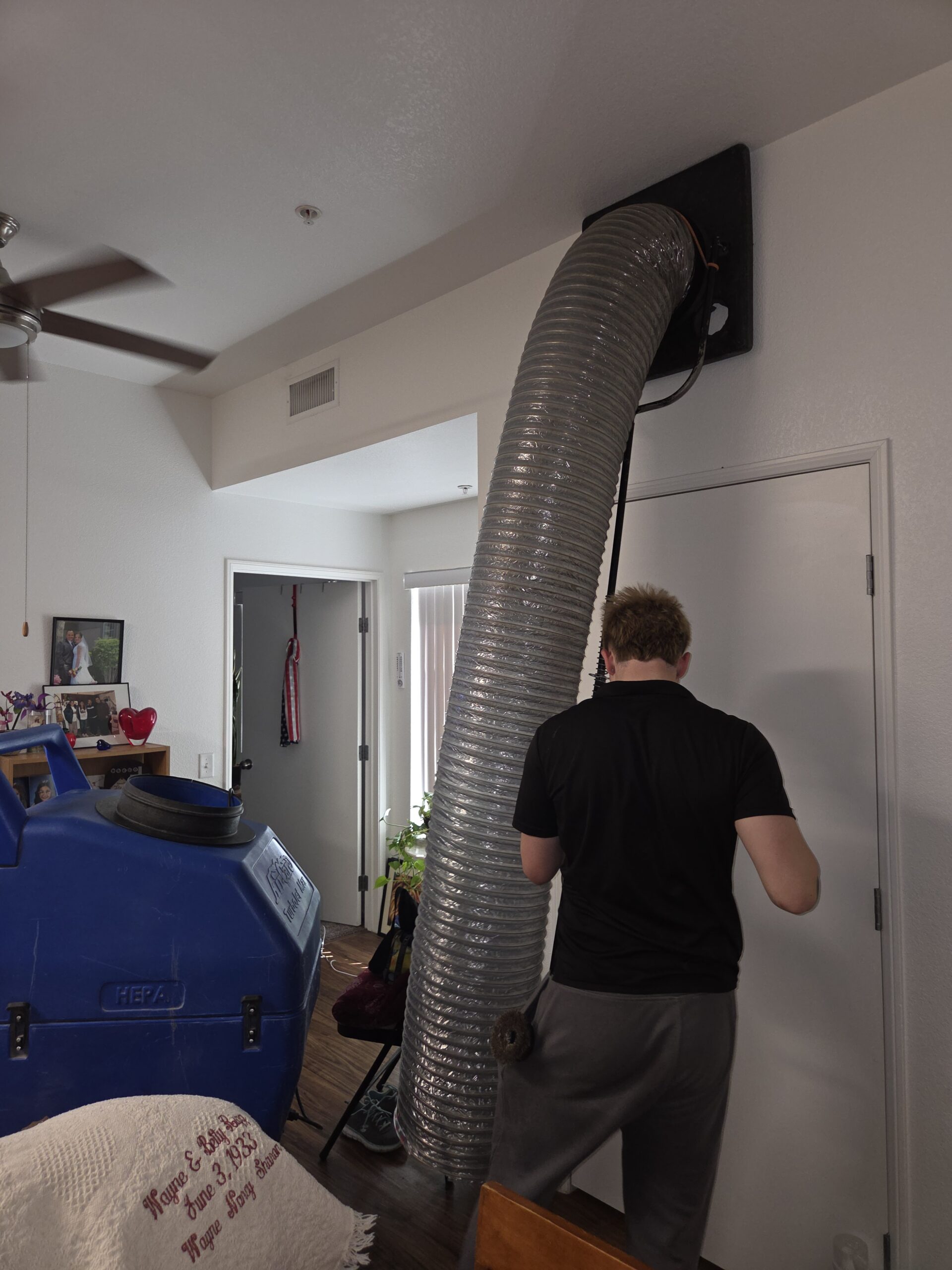
Most homeowners never think about their return air duct. It is just that big vent on the wall or ceiling that pulls air in. But if it is the wrong size, your entire HVAC system pays the price.
An undersized return air duct is one of the most common and most overlooked problems in residential HVAC. It forces your system to work harder than it should, increases your energy bills, shortens the life of your equipment, and causes comfort problems that are easy to misdiagnose as something more expensive. Here is what you need to know.
Key Takeaways
- The return air duct pulls air back to your HVAC system to be reconditioned and redistributed
- Most residential systems need approximately 400 CFM of airflow per ton of AC capacity
- An undersized return duct creates negative pressure, forces the system to strain, and causes noise, high bills, and uneven temperatures
- You can do a basic check yourself using your unit’s tonnage and a tape measure
- In Las Vegas, year-round AC use makes return duct problems show up faster and more severely than in most climates
What Is a Return Air Duct and What Does It Do?
Your HVAC system moves air in a loop. Supply ducts push conditioned air into your rooms. Return air ducts pull that air back to the air handler to be filtered, cooled or heated, and sent out again.
The return side is often undersized because it is less visible and less understood than the supply side. But the two sides need to be balanced. If your system can push out 1,400 CFM of conditioned air but only pull back 900 CFM through the return, the whole system is working against itself.
Think of it like breathing. Supply air is the exhale. Return air is the inhale. Try breathing out more than you breathe in and see how long that lasts.
Signs Your Return Air Duct Is Too Small
You do not need a technician to spot most of these. They are things you can notice yourself.
Whistling or rushing noise from the return vent Air being forced through a duct that is too small moves faster and creates noise. A loud whooshing or whistling from the return grille when the system runs is a classic sign of undersizing.
Rooms that never quite reach the set temperature When the system cannot pull enough air back, it cannot condition and redistribute enough air either. Some rooms stay stuffy or never cool down properly even when the thermostat is set correctly.
Doors slamming or feeling hard to open when the AC runs Closed doors create pressure imbalances when return airflow is restricted. Rooms with supply vents but no return path build positive pressure. You can feel it when you try to open a door.
Higher than expected energy bills A starved return forces your blower motor to work harder to move the same amount of air. That extra effort shows up on your electricity bill, particularly in Las Vegas where your system runs almost year-round.
System short-cycling When airflow is severely restricted, equipment can overheat or trip limit switches and shut off before completing a full cycle. If your system turns on and off frequently without fully cooling the space, restricted return airflow is worth investigating.
Collapsed or dirty filter faster than normal Excessive negative pressure from an undersized return can literally suck a filter inward. If your filter collapses or loads up unusually fast, the return duct may be creating more suction than the system was designed for.
How to Check Your Return Air Duct Size
You do not need to be an HVAC technician to do a basic check. Here is the process.
Step 1: Find your system’s tonnage Check the label on your outdoor condenser unit. The tonnage is usually listed directly, or you can find it in the model number. Common residential sizes are 2, 2.5, 3, 3.5, 4, and 5 tons.
Step 2: Calculate the airflow your system needs Multiply your tonnage by 400. That gives you the minimum CFM your return duct needs to handle.
- 2 ton = 800 CFM
- 2.5 ton = 1,000 CFM
- 3 ton = 1,200 CFM
- 3.5 ton = 1,400 CFM
- 4 ton = 1,600 CFM
- 5 ton = 2,000 CFM
Step 3: Measure your return duct Measure the width and height of your return duct opening in inches. Multiply those two numbers together to get the area in square inches.
Step 4: Check against the minimum A general rule of thumb is that your return duct needs roughly 2 square inches of duct area per CFM of airflow. So a 3-ton system needing 1,200 CFM needs at least 600 square inches of return duct area.
| AC Size | Min CFM Needed | Min Return Area (sq in) | Approx Round Duct Size |
| 2 ton | 800 CFM | 400 sq in | 22″ round |
| 2.5 ton | 1,000 CFM | 500 sq in | 24″ round |
| 3 ton | 1,200 CFM | 600 sq in | 26″ round |
| 3.5 ton | 1,400 CFM | 700 sq in | 28″ round |
| 4 ton | 1,600 CFM | 800 sq in | 30″ round |
| 5 ton | 2,000 CFM | 1,000 sq in | 34″ round |
These are starting points, not final engineering numbers. Actual sizing depends on duct length, number of bends, material type, and static pressure calculations. But if your return duct falls significantly short of these numbers, undersizing is almost certainly part of your comfort problem.
One Return Duct vs. Multiple Returns
Many homes, especially older Las Vegas construction, were built with a single centralized return duct. That design can work for smaller systems in well-sealed homes, but it has limitations.
When one return is usually fine:
- Systems under 2.5 tons
- Open floor plans where air can move freely to the return
- Homes where interior doors are rarely closed
When multiple returns make more sense:
- Systems 3 tons and above
- Homes where bedrooms are frequently closed off
- Two-story homes where the second floor consistently stays hotter
- Any situation where you notice pressure differences between rooms
When a room has supply air coming in but no return path, pressure builds up and that room becomes harder to condition. Adding a return duct to that room, or at minimum installing a transfer grille or door undercut, resolves it.
Why Las Vegas Makes This Worse
In most climates, an undersized return duct is an inconvenience. In Las Vegas, it becomes a much bigger problem faster.
Your system runs nearly 10 months out of the year. That means a blower motor straining against restricted return airflow is doing so almost continuously, not for a few months of summer. The wear adds up significantly faster than in moderate climates.
Las Vegas homes also tend to run larger systems, 3.5 to 5 tons is common for homes over 2,000 square feet, and larger systems demand proportionally larger return ductwork. Many older valley homes were built with return duct sizing that matched the original equipment but never got updated when the HVAC system was replaced with a larger unit.
If your system was replaced in the last 5 to 10 years and comfort problems started around the same time, the return duct is one of the first things worth checking.
What to Do If Your Return Duct Is Undersized
Option 1: Add a second return duct For most homes with a single undersized return, adding a second return duct is the most effective fix. This distributes the return airflow across two paths, reduces velocity and noise in each, and improves pressure balance throughout the home.
Option 2: Enlarge the existing return duct If structural constraints make adding a second return difficult, enlarging the existing duct and grille opening can increase capacity. This works best when the duct path can be widened without major construction.
Option 3: Add transfer grilles or door undercuts For individual rooms with pressure imbalance, transfer grilles cut through interior walls or a simple door undercut allows air to flow back toward the central return without a full duct run. These are lower-cost solutions that address room-level pressure problems.
Option 4: Get a professional assessment If you are unsure what your system actually needs, a static pressure test by a qualified HVAC technician gives you real data. This test measures the actual pressure your blower is working against and identifies whether return restriction is the issue.
Our HVAC repair service includes system diagnostics that cover airflow and static pressure issues, not just equipment failures.
How This Connects to Your Air Ducts
Return duct sizing and air duct cleanliness are connected problems. A return duct that is already borderline on size becomes effectively undersized when it is coated with years of dust and debris. The buildup reduces the usable cross-section of the duct and adds resistance to every cubic foot of air trying to pass through.
If your return is close to the right size on paper but your system is still showing symptoms of restriction, a professional air duct cleaning Las Vegas may resolve the issue without any duct modification. It is worth ruling out before committing to structural changes.
Regular air filter replacement services Las Vegas also plays a direct role here. A clogged filter sitting in the return path adds significant resistance on top of whatever the duct itself is contributing. In Las Vegas, filters should be replaced every 4 to 6 weeks during heavy cooling season.
Frequently Asked Questions
How do I know what size return air duct I need?
Start with your AC tonnage and multiply by 400 to get your minimum CFM requirement. Then check that your return duct has at least 2 square inches of cross-sectional area per CFM needed. A 3-ton system needs 1,200 CFM, which means at least 600 square inches of return duct area. Round duct, rectangular duct, and flex duct all have different airflow characteristics, so exact sizing should be confirmed by a professional.
Can a return air duct be too big?
No. A larger return duct moves air at lower velocity, which means less noise, less resistance, and less strain on your blower motor. Unlike supply ducts where oversizing can slow air too much and reduce throw, the return side benefits from being as large as practical. When in doubt, go bigger on the return.
Why is my return air vent so loud?
Noise from a return vent almost always means air is moving through too small an opening too fast. The fix is either enlarging the duct, adding a second return, or installing a larger grille with more free area. A dirty filter can also increase velocity and noise, so check and replace that first before assuming the duct itself is the problem.
Does one return vent work for a whole house?
It depends on the system size and floor plan. For smaller systems in open layouts, one well-sized central return can work effectively. For systems 3 tons and above, or in homes with many closed rooms, a single return typically creates pressure imbalances and comfort problems. Multiple returns, transfer grilles, or door undercuts help in those situations.
How does return air duct size affect energy bills?
A restricted return forces your blower motor to work harder to move the same amount of air. That extra effort consumes more electricity. In Las Vegas, where your system runs nearly year-round, the cumulative cost of an undersized return adds up significantly compared to a properly sized system running at normal static pressure.
Does Air Duct LV handle return air duct issues?
Yes. Our HVAC repair service covers system diagnostics including airflow assessment and static pressure testing. If your return duct is contributing to comfort or efficiency problems, we can identify it and walk you through the options before any work begins. We also offer commercial air duct cleaning Las Vegas for businesses dealing with similar airflow issues at scale.
Get a Free HVAC Inspection in Las Vegas
If your system is noisy, your rooms are uneven, or your energy bills are climbing without explanation, return air duct sizing is one of the first things worth checking. Air Duct LV has completed over 5,000 jobs across Las Vegas, North Las Vegas, Summerlin, Henderson, and the surrounding valley.
Call us at (702) 670-1532 or book online for same-day service. Inspections are always free.
Related Stories
How Air Duct Cleaning Reduces Your Energy Bills in Las Vegas
Las Vegas homeowners already pay some of the highest cooling bills in the country. Running
Jul
Air Duct Smell: What Each Odor Means and How to Fix It
That smell hitting you every time the AC kicks on is not just unpleasant. It
Jul
Return Air Duct Size: How to Know If Yours Is Right
Most homeowners never think about their return air duct. It is just that big vent
Jul
Does Cleaning Air Ducts Help With Allergies? What Las Vegas Homeowners Should Know
If your allergy symptoms feel worse indoors than outside, your air ducts are worth looking
Jul